
-

2026 GIST Faculty Openings (3rd Announcement)
Gwangju Institute of Science and Technology (GIST) -
English Language Lecturer for Spring 2027
Handong Global University -
Full-time Faculty in TESOL, Spring 2027
Cyber Hankuk University of Foreign Studies -
Visiting Professor Recruitment for Spring 2027
Yonsei University -
Faculty Recruitment Announcement for Non-Tenure Track Positions – Spring 2027
Dongguk University -
2027 Spring Faculty Opening Announcement
Kyung Hee University -
International Tenure-track Full-time Faculty in Computer Science and Engineering
Kyungpook National University -
2026-2 Recruitment Announcement for AI Fellow Positions
Korea Institute for Advanced Study (KIAS)
Korea Visa Guide for International Faculty and Researchers
UNIJOBS Visa Guide · Last reviewed September 2026
International faculty and researchers working in South Korea may require Professor (E-1), Research (E-3), or another status of stay that permits their proposed employment. The appropriate status depends on the position, duties, institution and applicant’s existing immigration status.
Research (E-3) status covers eligible research and development activities in natural science or advanced industrial technology.
A person who already holds an F-series status that permits the proposed employment may not need to change to E-1 or E-3, but this must be confirmed according to the exact F-series subtype and proposed duties.
Professor (E-1)
Application Eligibility
Professor (E-1) status applies to a person who meets the applicable qualifications under South Korea’s Higher Education Act and plans to engage in education or professional-field research guidance at a college, university or an equivalent educational institution.
Research (E-3)
Application Eligibility
Research (E-3) status applies to a person invited by a qualifying Korean public or private institution to engage in research and development in the natural sciences or advanced industrial technology. A person whose activities fall under Professor (E-1) status is excluded from the E-3 category.
General Distinction Between E-1 and E-3
| Status | Covered Activity | Institution |
|---|---|---|
| E-1 | Education or professional-field research guidance | College, university or equivalent educational institution |
| E-3 | Research and development in natural science or advanced industrial technology | Qualifying Korean public or private research institution |
When a position includes both teaching and research duties, the inviting institution should confirm the appropriate status with the responsible immigration authority.
How to Apply
The Korea Visa Portal lists the following application routes. The available route depends on the visa category, applicant, inviting institution and applicable eligibility requirements.
E-Visa Application
Application through the Korea Visa Portal for applicants who meet
the applicable electronic visa requirements.
Korean Diplomatic Mission
Visa application through the Korean embassy or consulate responsible
for the applicant’s place of residence.
Visa Issuance Confirmation via the Visa Portal
The inviting institution may apply for confirmation of visa issuance
through the Korea Visa Portal when the online procedure is available.
Visa Issuance Confirmation via Immigration
The inviting institution may apply through the immigration office
responsible for its location.
Electronic visa service is not automatically available to every E-1 or E-3 applicant. Applicants and inviting institutions should check the current eligibility requirements on the Korea Visa Portal.
Documents for an E-Visa Application
The Korea Visa Portal identifies the following documents and materials for an electronic visa application:
relevant status of stay
Additional documents may be required depending on the application route, institution and individual case, applicants or inviting institutions may also be asked to provide supporting documents.
Can F-Series Visa Holders Work at Korean Universities?
Employment rights differ significantly among F-series categories. Holding an F-series status does not automatically mean that all types of employment are permitted.
| Status | Category | Employment Information |
|---|---|---|
| F-1 | Family Visitor | Work not permitted |
| F-2 | Resident | Partial restrictions on employment |
| F-3 | Dependent Family | Work not permitted |
| F-4 | Overseas Korean | Employment is subject to applicable restrictions. Unskilled labor and certain other restricted activities are not permitted. |
| F-5 | Permanent Resident | No restrictions on employment |
| F-6 | Marriage Migrant | No restrictions on employment |
A person who already holds an F-series status that permits the proposed employment may not need to change to E-1 or E-3. The applicant and employer should confirm this based on the exact F-series subtype, proposed duties and current immigration requirements.
Official Information and Sources
For case-specific guidance, contact the Immigration Contact Center at 1345 from within South Korea or consult the Korean diplomatic mission responsible for the applicant’s place of residence.
This guide provides general information and does not constitute legal or immigration advice. Visa rules, permitted activities, required documents and application procedures may change. Applicants and employers should verify current requirements through the Korea Visa Portal, HiKorea, the Korea Immigration Service, Immigration Contact Center 1345 or the responsible Korean diplomatic mission.
Looking for an academic career in Korea?
Browse current faculty and research opportunities.
Universities by Region
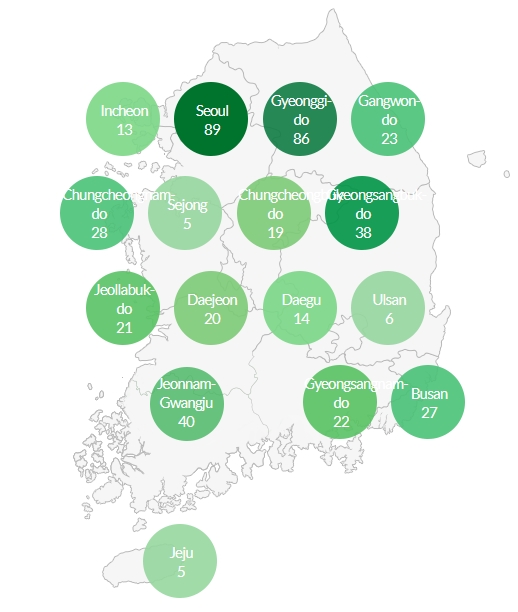
- Search results include college campuses, etc., and may be more than the number of universities to be announced.
Source: https://academyinfo.go.kr/ (KOGL Type 1)
Which Korean universities employ the most international professors?
UNIJOBS Data Guide · 2025
A data-led look at South Korean universities with the highest reported numbers of international faculty members, based on 2025 institutional disclosures.
Top 10 Universities by International Faculty Count
Number of international faculty members reported for 2025
Source:
대학알리미 (Academy Information), 2025 institutional disclosures. Compiled by UNIJOBS.
Methodology:
Institutions are ordered by their disclosed number of international faculty members. These figures describe faculty composition and do not independently indicate current job availability, employment conditions, or overall employer quality.
Looking for an academic career in Korea?
Browse current faculty and research opportunities.
When do Korean universities recruit faculty?
Korean universities generally begin their spring semester in March and their fall semester in September. Faculty positions are therefore commonly advertised several months before each semester begins.
For positions beginning in March:
Check vacancies mainly from August to November of the previous year.
For positions beginning in September:
Check vacancies mainly from February to May of the same year.
These are typical recruitment periods, not fixed national schedules. Visiting faculty, adjunct, language-teaching, research, and replacement positions may be advertised throughout the year. Application deadlines also vary by university and position.
Can foreign nationals apply for academic jobs in South Korea?
Yes. Foreign nationals can apply for university teaching, research, and other academic positions in South Korea.
UNIJOBS is dedicated to connecting international academics and researchers with employment opportunities at Korean universities and research institutions. Eligibility requirements vary by position, so check each job posting for qualifications, experience, language requirements, and visa information.
Applications should be submitted according to the instructions in each job posting.
Can I send my application to you?
No. UNIJOBS does not accept or process job applications.
To apply, follow the instructions in the individual job posting and submit your application directly to the recruiting institution. Application methods and required documents vary by employer.
Korean Standard Time (KST)
Korea Standard Time (KST) is the standard time zone in South Korea and is 9 hours ahead of UTC (GMT +09:00).
【공고 게재 문의】How can I post a job?
To post a job, first create an employer account using your name and email address. Then select “Post a Job” from the website menu and complete the job submission form.
After submitting the job details, proceed with payment. UNIJOBS staff will review the advertisement before it is published.